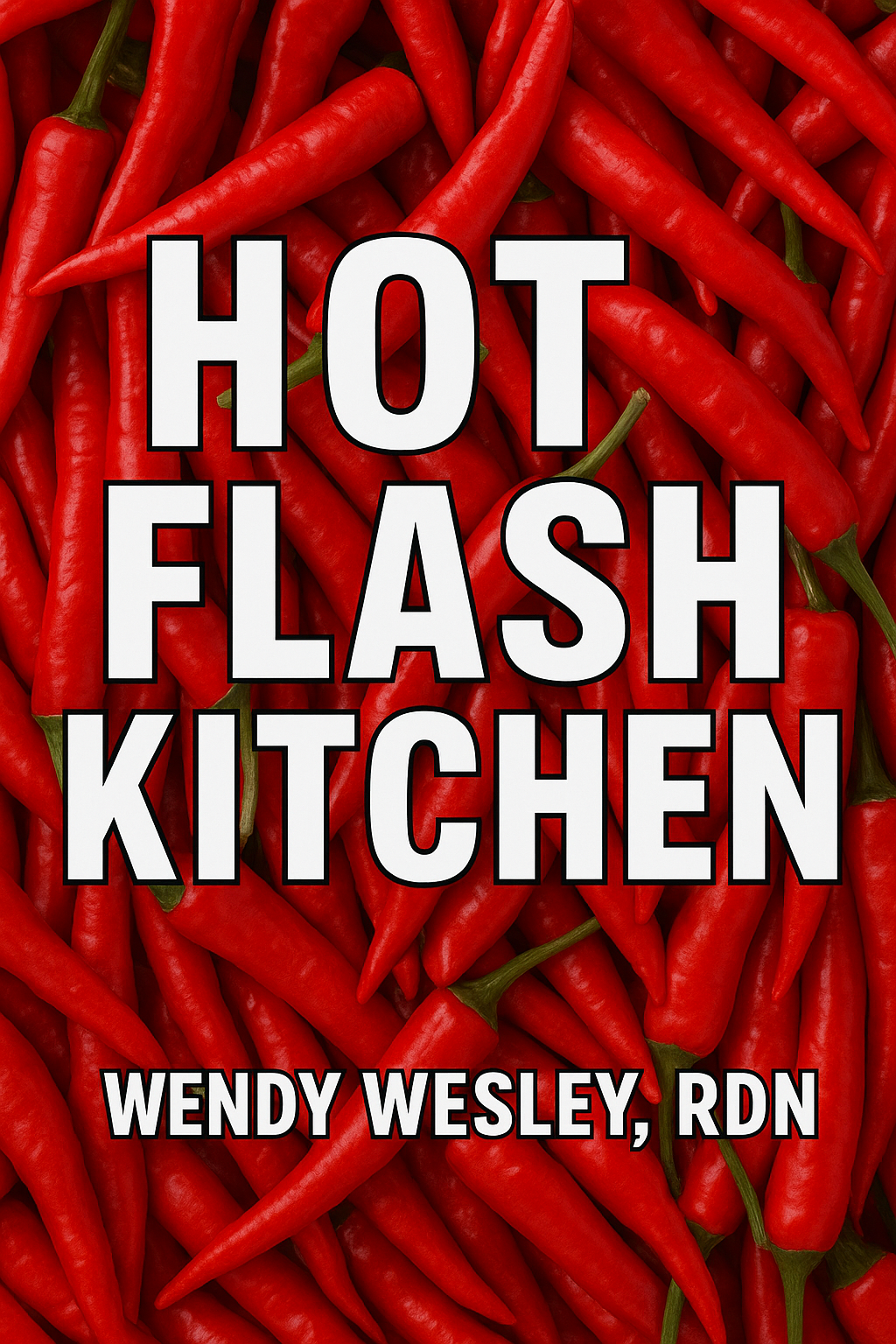
Excerpt from “Hot Flash Kitchen” by Wendy Wesley, RDN
INTRODUCTION
Dedicated to the woman at the Hillsborough Community College lecture who asked, “Is everything you’re teaching found in a book somewhere?”
“What I used to do isn’t working anymore.” - Emma’s story
“I’m panicking, Wendy. The weight is coming on fast and I’m quickly outgrowing some favorite items in my closet like my weekend jeans and work pants. I can’t wait to remove my bra and that never used to happen. The weight is concentrated on my belly and I feel like I have lost control, like my body is not mine anymore. I’m desperate and lost. I tried cutting back here and there and that used to do the trick. Even just 5 years ago I could shave a few pounds by cutting back or hitting the gym a little harder. But it’s not working and the weight is coming on. I feel like what I used to do isn’t working anymore.” – Emma J. 53 years old
The above quote from my patient properly encapsulates the problem my peri-, menopausal and post-menopausal women experience. I often hear the phrase, “what I used to do isn’t working anymore” with frustrated and panicked tones attached to it.
We all have hard-wired patterns of eating locked in our brains that are shaped over decades of food experimentation. During the menopause phase, which may last 7 – 10 years, what used to work may not be enough to prevent significant weight gain and avoid chronic metabolic disease.
It’s time for a new approach to food and nutrition in the latter third of our lives. The eating patterns we developed in early adulthood often meant we could maintain our weight and stay disease-free.
Wedding or reunion coming up? Cut a little here, a little there, hit the gym and 7-10 pounds could easily fly off just in time to get back into that dress.
Drinking on the weekends? Sure. A little discipline on Monday and Tuesday could correct that quickly.
A lot of indulgences over the holidays? A new gym membership and a dry January could erase those mistakes in 28 days flat.
Into our late 40s we noticed a shift to that efficient formula. The weight came off slower or not at all and indulgent seasons were more difficult to bounce back from. Most insidiously, the hope and belief that we could control this one piece of our lives began to leave us. A mild panic set in. Things began to look and feel differently but no one was talking about it.
You may have asked yourself, “Is this all in my head? Do I have a mysterious disease? Should I have my thyroid checked? Am I the only one?”
I assure you it’s not in your head, you don’t have a mysterious disease, it’s likely not your thyroid and you are not the only one.
I have been writing this book in my head and in social media posts and articles for a decade as I have gone through “the change” myself. While writing and “changing,” I counseled and educated hundreds of women between the ages of 45 to 65 experiencing their own “change.”
Several generous women gave me permission to feature their “meno-stories” with names and details altered to protect their privacy. You will see their thoughts, struggles, frustrations and victories interspersed in each chapter. I am truly grateful to them for that and for teaching me so much.
In this book I cover weight gain, intake of macro and micro nutrients for optimal health, the progression of metabolic disease, alcohol, ultra processed foods, basic cooking and food storage techniques and a few of my favorite recipes. All of it put together is intended to give you a nutrition roadmap to follow during this time. With loads of misinformation and powerful marketing messages out there, making sense of this time in your life can overwhelming.
As a postmenopausal woman, I know it is possible to lose weight, have more energy and avoid chronic disease through food ONLY if I am realistic and make health a daily priority. This book will show you how to embrace what you can control and cut through the clutter and noise of all the nutrition-related misinformation out there.
I have been cooking, thinking about food and writing recipes since I was 8 years old and practicing nutrition professionally since 2016. In that time, I have seen several patterns emerge about food and human behavior. The longer I do this the easier it is to predict where my clients and patients have been, what got them there and what motivates them.
I suppose that is the way with any kind of practitioner be it law, dentistry or social work: patterns emerge that shape human behavior and the professional can design a program for the typical person in need.
Human behavior is fascinating. I have always been interested in how we change – or not. Motivations for change and the barriers for it are complicated. Since we don’t exist in a bubble our environment shapes us. The American food environment is difficult, and people fall into routines and habits that the environment shapes.
The next decade of research, opinions, supplements, diets, discussion, opinions and programs targeting menopause management will be massive as the gargantuan Millennial generation enters peri-menopause.
You thought Generation X women made some meno-noise, just wait. The menopause nutrition conversation is just getting started and I’m thrilled to share my training and experience with you.
“It’s like the perfect storm for weight gain.” -- Amy’s story
“Now that I look at the last 15 years from a 1000-yard view I can see the weight gain clearly and because I see how and why it happened and I feel like I’m ready to correct it. It started slowly and I was ignoring it. Truth is I was having too much fun with life and I didn’t want to change anything. I think I knew that my life was the reason. The restaurants, going to friends’ houses, grazing all the time, travel and wine. So much wine.
“Another thing happened during this time is my kids grew up. I wasn’t chasing them around anymore. I had free time available to me as my kids became teenagers and gained independence. I still drove them places but I wasn’t chasing them and worrying if they were hurt. It’s a different kind of worry.
“I remember eating but never really feeling hungry or ever full. Just always grazing. I’d wake up at 6 am and eat a yogurt with granola and never realizing that was around 40 grams of pure sugar. I wasn’t eating doughnuts and Danish so I thought I was making good choices. But I craved sugar all day. I didn’t make a mental connection between sugar in cookies and sugar in yogurt. It’s the same sugar but I believed it was different. When you said that breakfast in America is dessert, that clicked. I have been thinking about this for a long time.
The other thing I realized is that I have more money today than I ever have. And more time. I believe I worked hard so I deserved wine. A lot of wine. You’re told that you have a hard life with all these kids and a challenging career and you deserve to drink wine because life is hard. I bought into all of that. So between eating refined carbs and drinking tons of wine, I’m carrying around 35 extra pounds. I’d do some things differently like exercise and a few pounds would come off but I couldn’t keep that going. So that weight would come back on and bring a few friends with it.
”So that’s where I am and I need a fresh set of eyes on me because I am unhappy with the way I feel and look.” - Amy D. , 55 years old
Weight loss is the number one reason women ask for my help before, during and after menopause. Aesthetically, the sudden and often rapid increase in weight is incredibly distressing. It seems to come out of nowhere and catches women by surprise.
Healthwise, excess body fat increases a woman’s risk for heart disease, type 2 diabetes and cancer. It can also exacerbate hot flashes. Excess weight can also increase joint and back pain and cause sleeping issues.
For some women, this is the first time their weight has bothered them. Discussions around weight are delicate and should not be framed as moral issues. In fact, obesity is identified as a disease with medical professionals and researchers beginning to better understand and recognize different types of obesity through genetic testing. Someday, we may be able to prescribe specific drugs to treat obesity just we do with chemotherapy and cancer.
Research shows that most of us, on average, will gain 1.5 pounds per year in our 40s and 50s. This average is completely independent of race or initial weight. Some women go through menopause without gaining any additional pounds but, as peri-menopause starts to emerge, even women who have been thin their entire lives may notice extra padding around the but, hips and belly.
Janelle, 54, complained to me that she can no longer wear her size 2 shorts.
“Nothing has changed with food and exercise,” she complained. “But I cannot easily wear my favorite clothes. What’s going on?!”
This is the same repeated story I hear from my clients who all have the same complaint: What I used to do is not working for me anymore.
“That’s Not Going to Work for Me After Menopause” – Joyce’s Story
“I remember logging my food for the first time and it threw me a bit. Seeing what I ate on paper was jarring and I knew it would be. I think that’s why I always said that tracking wouldn’t work for me. I really didn’t want to do it. I had a big bakery bagel on my log and you asked how many times each month I eat bagels. I answered just a few times. It’s no big deal. Then you asked what else do you have a few times each month. That’s when I started to see that when some foods are eaten a few times a month that’s not the whole story. I also ate pizza, lasagna, candy, chips, fast food, fries, ice cream and soda a few times each month. Over a month, “a few times” of different foods really adds up. I can have these things but not at this frequency. That’s not going to work for me anymore after menopause.” – Joyce C., 49 years old
THE “WHY” OF WEIGHT GAIN DURING MENOPAUSE
Menopause weight gain is a common experience caused by a combination of hormonal changes, the natural aging process or sarcopenia and lifestyle factors like poor sleep and reduced physical activity. Weight gain typically begins during peri-menopause and often settles around the abdomen, a type of fat called visceral fat, which poses increased health risks.
Hormonal Shifts:
The decline in estrogen and progesterone levels change how the body stores fat typically promoting the accumulation of visceral fat around the midsection rather than the hips and thighs. Lower levels of these hormones slow down a women’s basal metabolic rate while increasing her appetite.
These hormone shifts can promote insulin resistance leading to more fat storage and fewer calories burned. Additionally, sleep may be interrupted by these hormonal shifts causing a woman to have an increased appetite to fuel a tired brain.
Age-related Muscle Loss or Sarcopenia:
Sarcopenia is the natural loss of muscle as we age and it if accelerated during menopause due to declining estrogen, progesterone and testosterone. This process leads to increased systemic inflammation, weakness and overall risk of falls. Effective management requires resistance training, adequate protein intake and for some, hormone therapy.
As women age, we naturally lose muscle mass which burns more calories than fat, slowing down our metabolism. If calorie intake isn't adjusted, weight gain is the likely result.
Lifestyle Factors:
Poor Sleep: Hot flashes and night sweats can disrupt sleep, leading to increased levels of the stress hormone cortisol, which encourages fat storage and can trigger cravings for high-calorie foods.
Decreased Activity: Many people become less active as they age, burning fewer calories daily.
Genetics: A family history of carrying weight around the abdomen may increase your likelihood of doing so during menopause.
A NUTRITION PROGRAM FOR MENOPAUSE WEIGHT LOSS
This book contains the nutrition program I use to help peri-menopausal and menopausal and post-menopausal women feel better, lose weight, and avoid chronic disease as they transition through this time in their lives.
In my university nutrition training, menopause nutrition was never discussed. A broad category of “women’s health” was but the topics centered around conception, pregnancy and lactation but, menopause, specifically weight gain, was not. The menopause nutrition program I have created in this book is the product of experimentation, trial and error.
I began my nutrition counseling career a decade ago in an acute care hospital where calories ruled. Every patient was assessed for caloric, fluid and protein needs based on their disease or condition. When counseling a patient on weight management, I preached calorie counting and restriction.
You likely already know this, but calorie restriction diets don’t work for the long haul. You may have set your resolve to finally get on track and lose weight. You likely researched a diet plan or bought a new book. Maybe you paid for an online course.
You may have joined a gym or an exercise program. Then you went shopping for workout equipment or clothing. After that, you may have purchased supplements, protein powders or all vegan or non-GMO foods and spent a fortune at the grocery store for all organic vegetables, fruits and frozen dinners to eventually give up after the restriction and intensity became too difficult.
You may have repeated this routine many times over the course of menopause. I know that I have. We think that if our willpower and resolve are powerful enough, we can lose weight. Many of us did lose weight but the intensity was too much and the expectations were too unrealistic to maintain.
Maintaining weight loss must be about consistency and never about intensity. This is why an intense focus on calorie counting is doomed to fail.