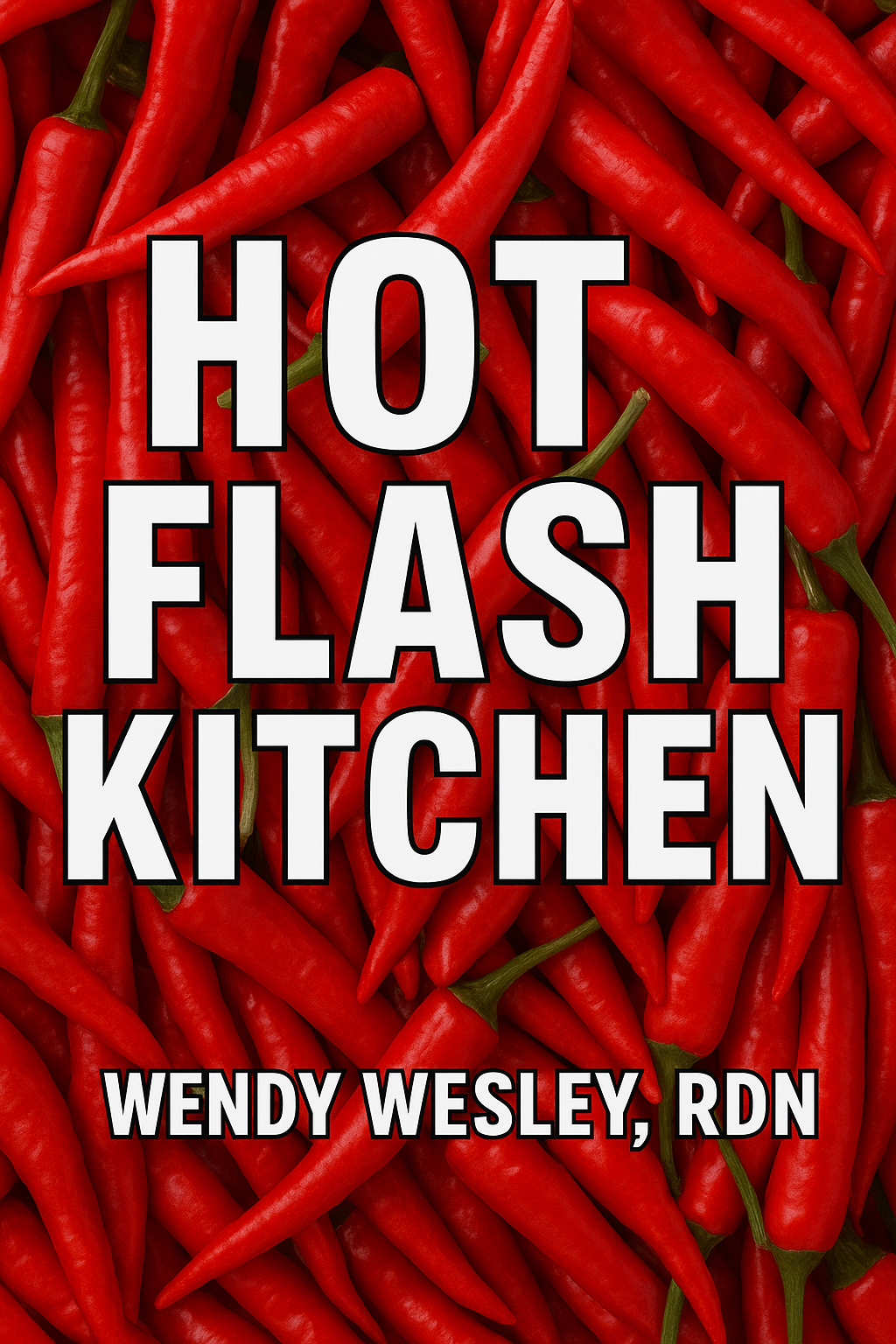
My menopause nutrition book, “Hot Flash Kitchen” will be published this Fall. Below is an excerpt from my introduction.
Dedicated to the woman at Hillsborough Community College who asked, “Is everything you’re teaching found in a book somewhere?” OR “I’ve tried all the quick fixes and crash diets and nothing stuck. I’m ready for the diet I’ll follow for the rest of the years I’m on this planet.”
“What I used to do isn’t working anymore.” - Emma’s story
“I’m panicking, Wendy. The weight is coming on fast and I’m quickly outgrowing some favorite items in my closet like my weekend jeans and work pants. I can’t wait to remove my bra and that never used to happen. The weight is concentrated on my belly and I feel like I have lost control, like my body is not mine anymore. I’m desperate and lost. I tried cutting back here and there and that used to do the trick. Even just 5 years ago I could shave a few pounds by cutting back or hitting the gym a little harder. But it’s not working and the weight is coming on. I feel like what I used to do isn’t working anymore.” – Emma J. 53 years old
The above quote from my perfectly patient properly encapsulates the primary problem my peri- and post-menopausal women experience. I often hear the phrase, “what I used to do isn’t working anymore” with a frustrated and panicked tone attached to it.
We all have hard-wired patterns of eating locked in our brains that are shaped over decades of food experimentation. During the menopause phase, which may last 7 – 10 years, what used to work may not be enough to prevent significant weight gain and avoid chronic metabolic disease.
Full stop: It’s time for a new approach to food and nutrition in the latter third of our lives.
The eating patterns we developed in early adulthood often meant we could maintain our weight and stay disease-free.
Wedding or reunion coming up? Cut a little here, a little there, hit the gym and 7-10 pounds could easily fly off just in time to get back into that dress.
Drinking on the weekends? Sure. A little discipline on Monday and Tuesday could correct that quickly.
A lot of indulgences over the holidays? A new gym membership and a dry January could erase those mistakes in 28 days flat.
Into our late 40s we noticed a shift to that efficient formula. The weight came off slower or not at all and indulgent seasons were more difficult to bounce back from. Most insidiously, the hope and belief that we could control this one piece of our lives began to leave us. A mild panic set in. Things began to look and feel differently but no one was talking about it.
You may have asked yourself, “Is this all in my head? Do I have a mysterious disease? Should I have my thyroid checked? Am I the only one?” I assure you it’s not in your head, you don’t have a mysterious disease, it’s likely not your thyroid and you are not the only one.
ABOUT “HOT FLASH KITCHEN”
I have been writing this book in my head and in social media posts and articles for a decade as I have gone through “the change” myself. While writing and “changing,” I counseled and educated hundreds of women between the ages of 45 to 65 experiencing their own “change.” Several gave me permission to feature their “meno-stories” with names and details altered to protect their privacy. You will see their thoughts, struggles, frustrations and victories interspersed in each chapter. I am truly grateful to them for that and for teaching me so much.
In this book I cover weight gain, intake of macro and micro nutrients for optimal health, the progression of metabolic disease, alcohol, ultra processed foods, basic cooking and food storage techniques and a few of my favorite recipes. All of it put together is intended to give you a nutrition roadmap to follow during this time. With loads of misinformation and powerful marketing messages out there, making sense of this time in your life can overwhelming.
As a postmenopausal woman, I know it is possible to lose weight, have more energy and avoid chronic disease through food ONLY if you are realistic. This book will show you how to embrace what you can control and cut through the clutter and noise of all the nutrition-related misinformation out there.
I have been cooking, thinking about food and writing recipes since I was 8 years old and practicing nutrition professionally since 2016. In that time, I have seen several patterns emerge about food and human behavior. The longer I do this the easier it is to predict where my clients and patients have been, what got them there and what motivates them.
I suppose that is the way with any kind of practitioner be it law, dentistry or social work: patterns emerge that shape human behavior and the professional can design a program for the typical person in need.
Human behavior is fascinating. I have always been interested in how we change – or not. Motivations for change and the barriers for it are complicated. Since we don’t exist in a bubble our environment shapes us. The American food environment is difficult, and people fall into routines and habits that the environment shapes.
We are always floating among these three areas of change:
- Unaware of the problem/issue
- Contemplative where possible solutions are being considered
- Mindfulness where change is actively afoot
There is no right or wrong way to enter or exit these phases. Each person is on their own path and it is why I included personal stories in this book. It is my hope that you see yourself these women and glean from their honesty.
I changed names, details, places, situations and other identifying details. Each story is gleaned from a basic framework of a person’s experience with food as it related to menopause. I think what you will find is the common thread of mindfulness.
The next decade of research, opinions, supplements, diets, discussion, opinions and programs targeting menopause management will be massive as the gargantuan Millennial generation enters perimenopause.
You thought Generation X women made some meno-noise, just wait. The menopause nutrition conversation is just getting started and I’m thrilled to share my training and experience with you.